A production proposal for Opera Holland Park

Madama ButterflyDandelion

Jihoon Kim
01 — Why

The Dandelion

Dandelion: root, yellow bloom, white seed head

Although the dandelion is often considered a weed, this humble flower has captivated the Japanese people for centuries. Its meanings are richly woven into the fabric of their society, and it is seen as a symbol of resilience and hope.

In the Japanese language of flowers Dandelion means ‘true-hearted love’. The meaning comes from the way the flower stands straight and faces the sun: a steady, unwavering love. It also denotes ‘parting’, from the seeds blowing away in the wind. So, in one flower you have both faithful love and separation, which is Butterfly’s whole story in a single image.

Cio-Cio-San is carrying two kinds of faithfulness. One is her constancy to Pinkerton after the marriage. The other is her faithfulness to who she is, the Japanese self she returns to at the end. The same unwavering heart both destroys her and gives her back her dignity.

Dolore

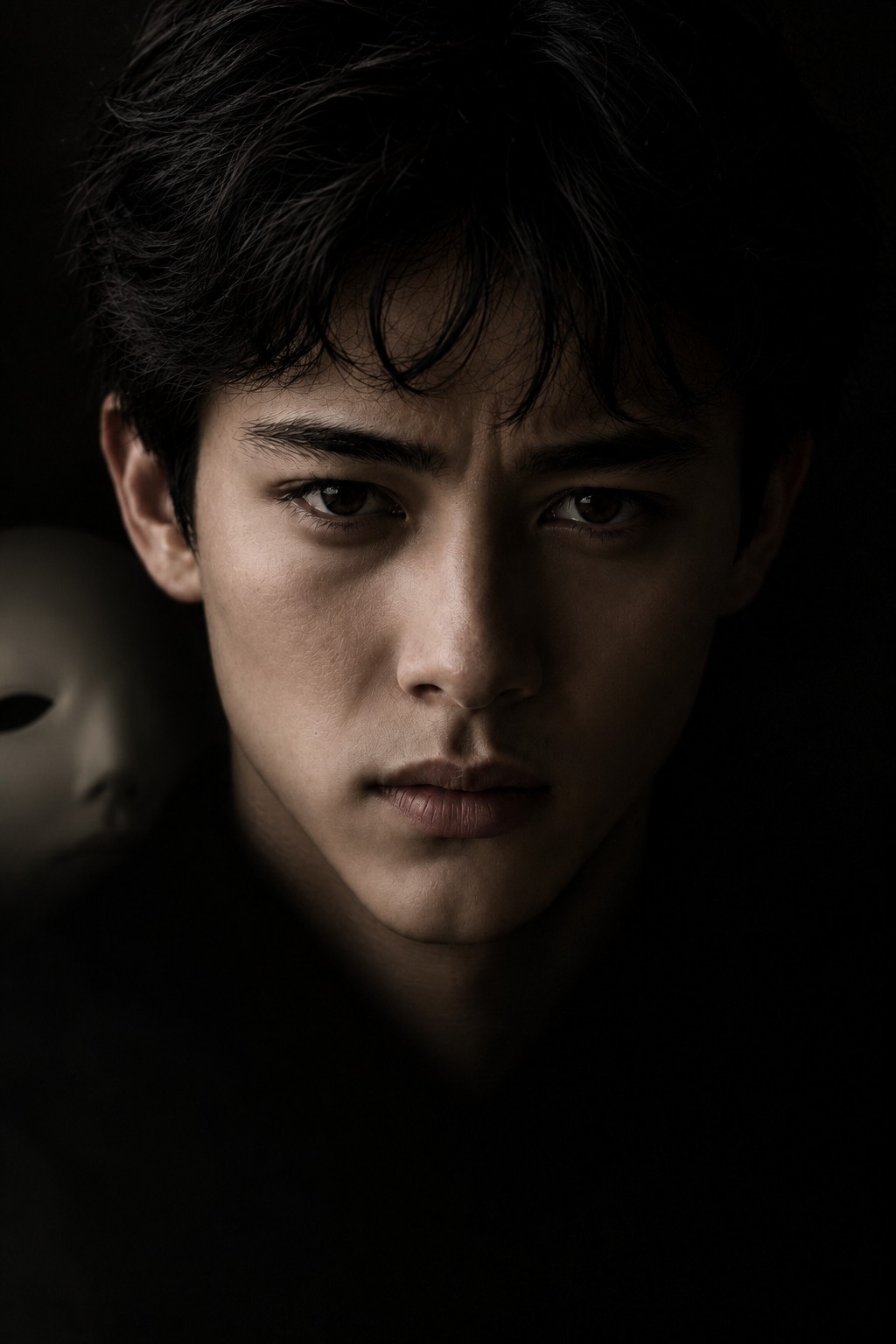
Dolore, grown, with a mask at his shoulder

Dolore is Cio-Cio-San’s son. He never speaks a word, yet in this production everything turns on him. The story does not end with his mother’s death. He is the one who has to keep living.

He belongs nowhere. In Japan he is an ainoko, a slur for a mixed-race child. In America he would be a Eurasian. Neither country wants him. His name is Dolore — sorrow. His mother swears it will turn to joy when his father returns. The day his father returns, his mother dies. His name never turns to joy. Not a chapter of his life, but the whole of it.

02 — Frame

Twenty years later

The whole opera is the story Suzuki tells Dolore

Around 1920, in Nagasaki, a woman sits facing a young man of seventeen and tells him, for the first time, who his mother was and how she died. The woman is Suzuki. She had been a servant to his parents and after his father left for America and his mother died, she was the person who raised him. The young man is Dolore. His mother was Cio-Cio. He is mixed-race and, as such, had a difficult childhood. Suzuki wants him to know who his parents were.

Cio-Cio became a geisha after her family fell into ruin. A geisha entertained people through dance, music and conversation. Contrary to Western opinion, geisha were not prostitutes. In Japan at that time, the difference between the two was absolute. Her geisha name was Cio-Cio (蝶々), meaning ‘butterfly’. That name was translated into English and taken as hers — ‘Butterfly’ — but it was only a Westernised version, given from outside. But under that name, Suzuki knew someone else entirely. A dandelion. Recognising the strength of Cio-Cio, Suzuki associated her with this plant. For her, Cio-Cio was the dandelion, rooted deep in the earth, tenacious, shining yellow, the colour of the sun, that turns magically to the delicacy of the seed head poised to shatter and release the floating strength of new life. That is what Suzuki saw in Cio-Cio. A dandelion survives being stepped on. Its roots go too deep to pull out easily and those roots are her origin. It is strong wherever it grows. A dandelion also blooms twice. First it takes nourishment from those roots and blooms yellow. When that flower is gone, it blooms again as a white head of seeds. Both come from the same deep root. The second breaks apart, rises into the air, lands on some new ground and puts down its own roots. The flower ends, but the root does not. The seed continues it.

Later in the opera, Bonzo, Cio-Cio’s uncle and a Buddhist monk, is forced offstage at gunpoint. For a moment it can look as though the old faith and the ways of the ancestors have been broken by force. But only the monk has been driven away. The roots he protected cannot be driven away. They come back in Cio-Cio’s constancy through three years of waiting. At the end she returns to her roots, using her father’s traditional sword to commit suicide. However, that root is not destroyed. It lives on in Dolore, a seed carried to new ground. The butterfly’s life is ended, but the dandelion lives on.

03 — Story

The story, through the doors

From the prologue to the last seed

Prologue

Prologue

Two musicians, one with a Western instrument and one with a Japanese instrument, play the American and Japanese national anthems at the same time (both anthems are played in the opera). While the two melodies play against each other they lose their shape and stop being ‘music’. What is left is noise, though it isn’t unpleasant to hear.

Some masked children are playing while another group of children walk together. Except for one; that child has no mask and is on his own, watching a game he cannot join and walking alone behind the others. He is Dolore, son of Cio-Cio. Born from two bloodlines but belonging to neither, he grows up outside the group, carrying the pain of his mother’s suicide.

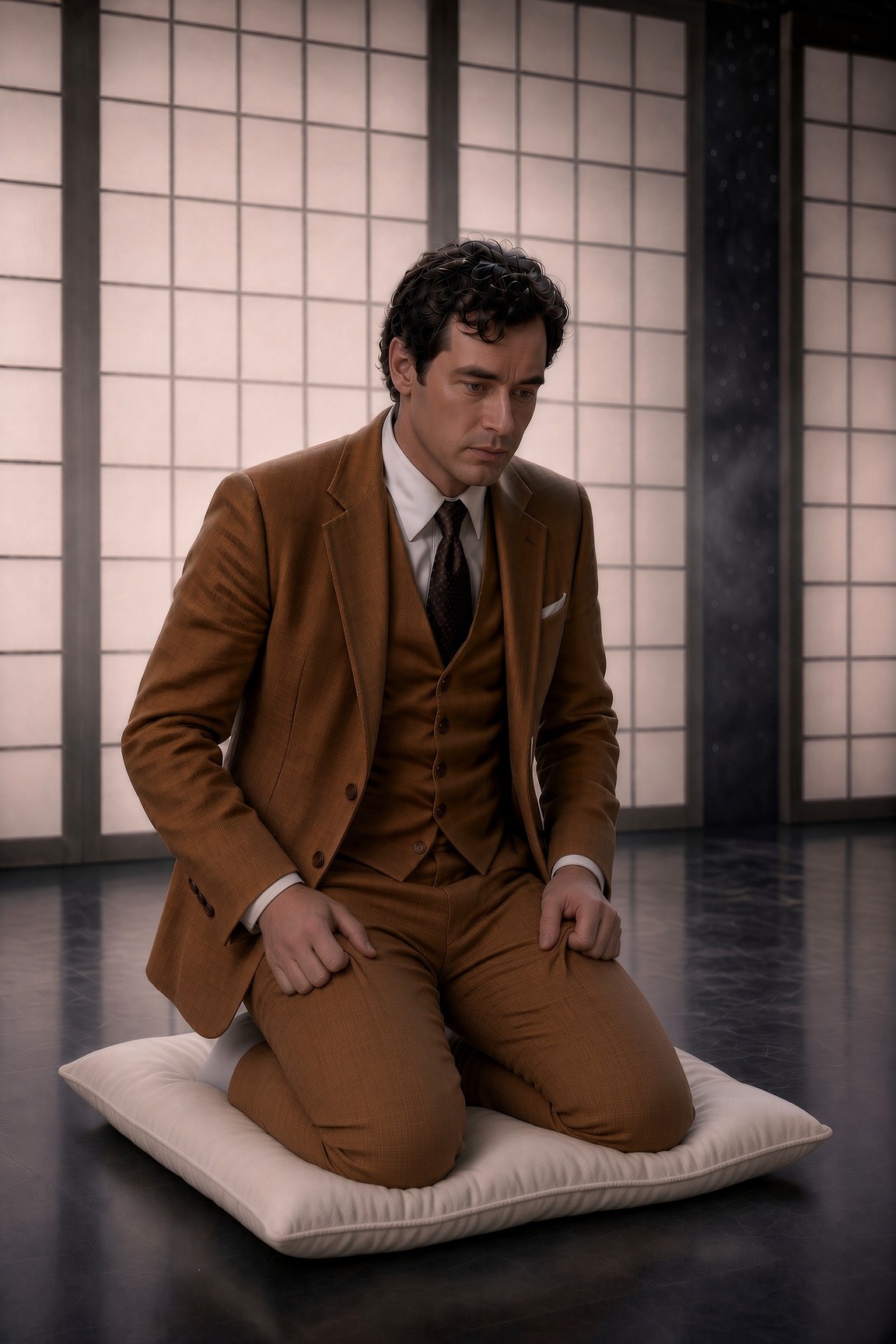
At one side, two people are sitting. Suzuki, now old, and Dolore, now grown. Suzuki has just finished the story. Dolore has finally heard who his mother was and how she died. He falls to his knees in distress.

While he is crying, the story Suzuki has told begins again, now as the opera. When it reaches the end, we come back to this moment, to this same crying. Dolore has now understood the sacrifice his mother made.
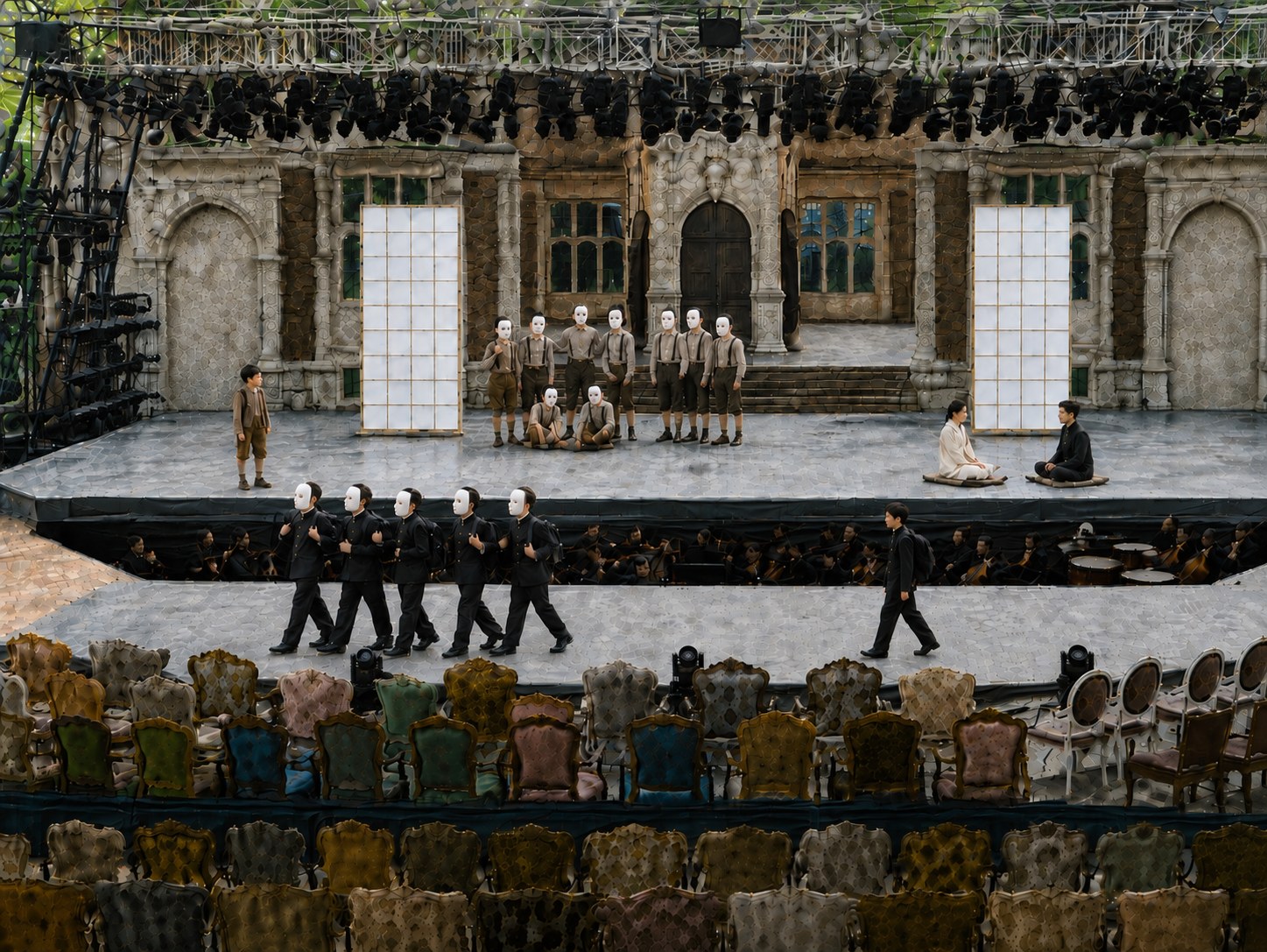
Prologue: masked children, Dolore apart, Suzuki and grown Dolore on the Holland Park stage

Act I. The house and the stage

Act I. The house and the stage

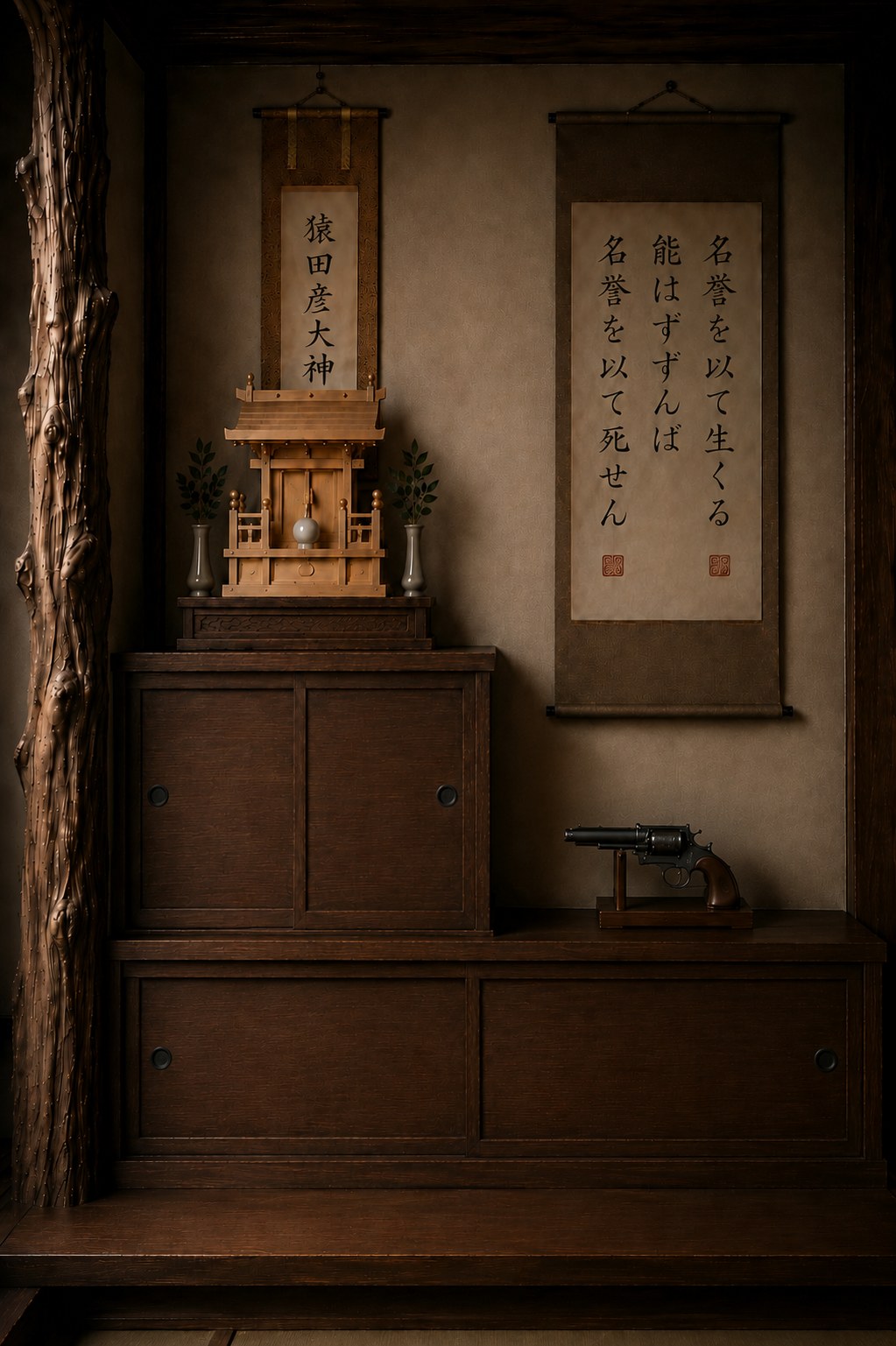
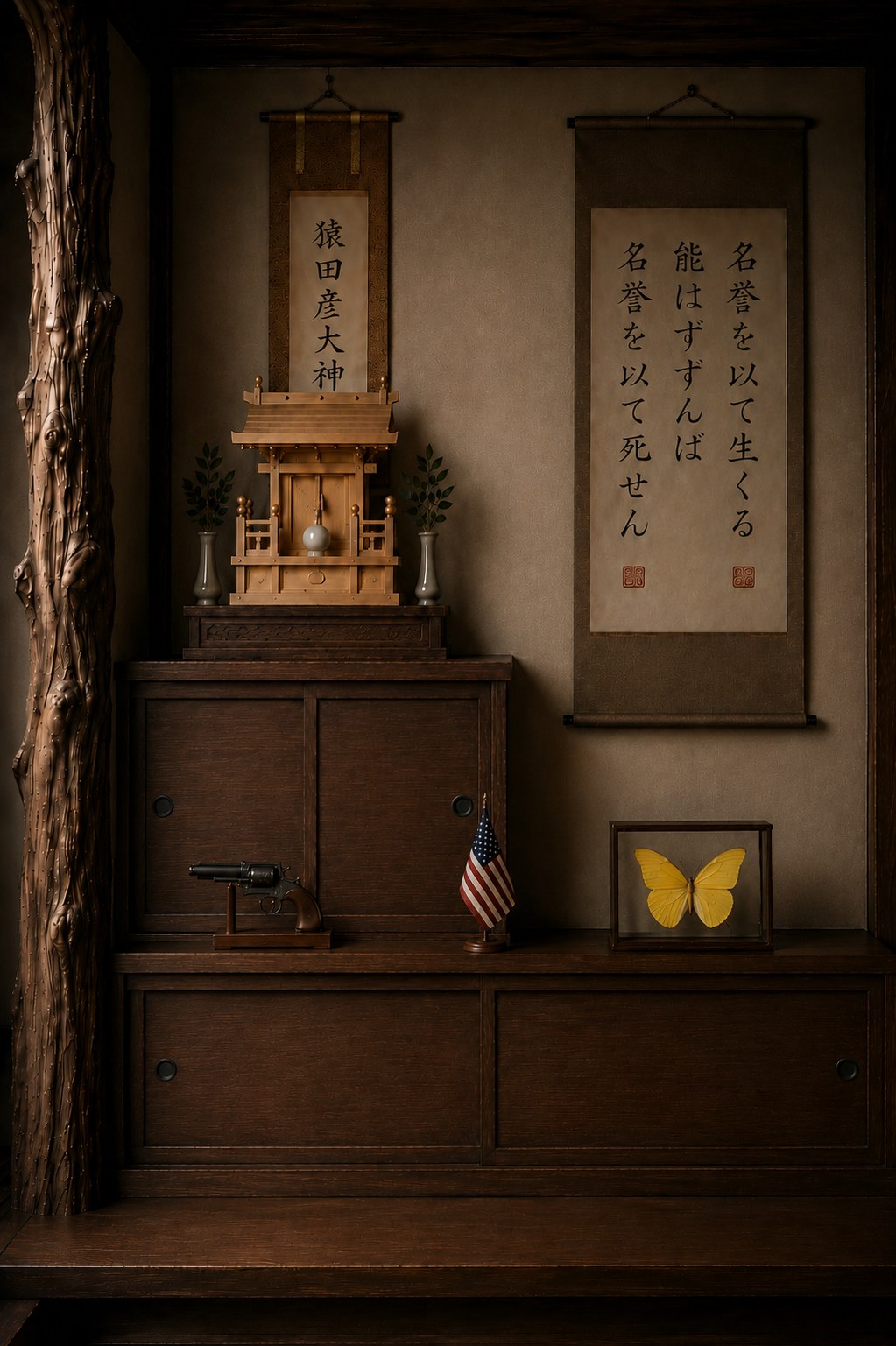
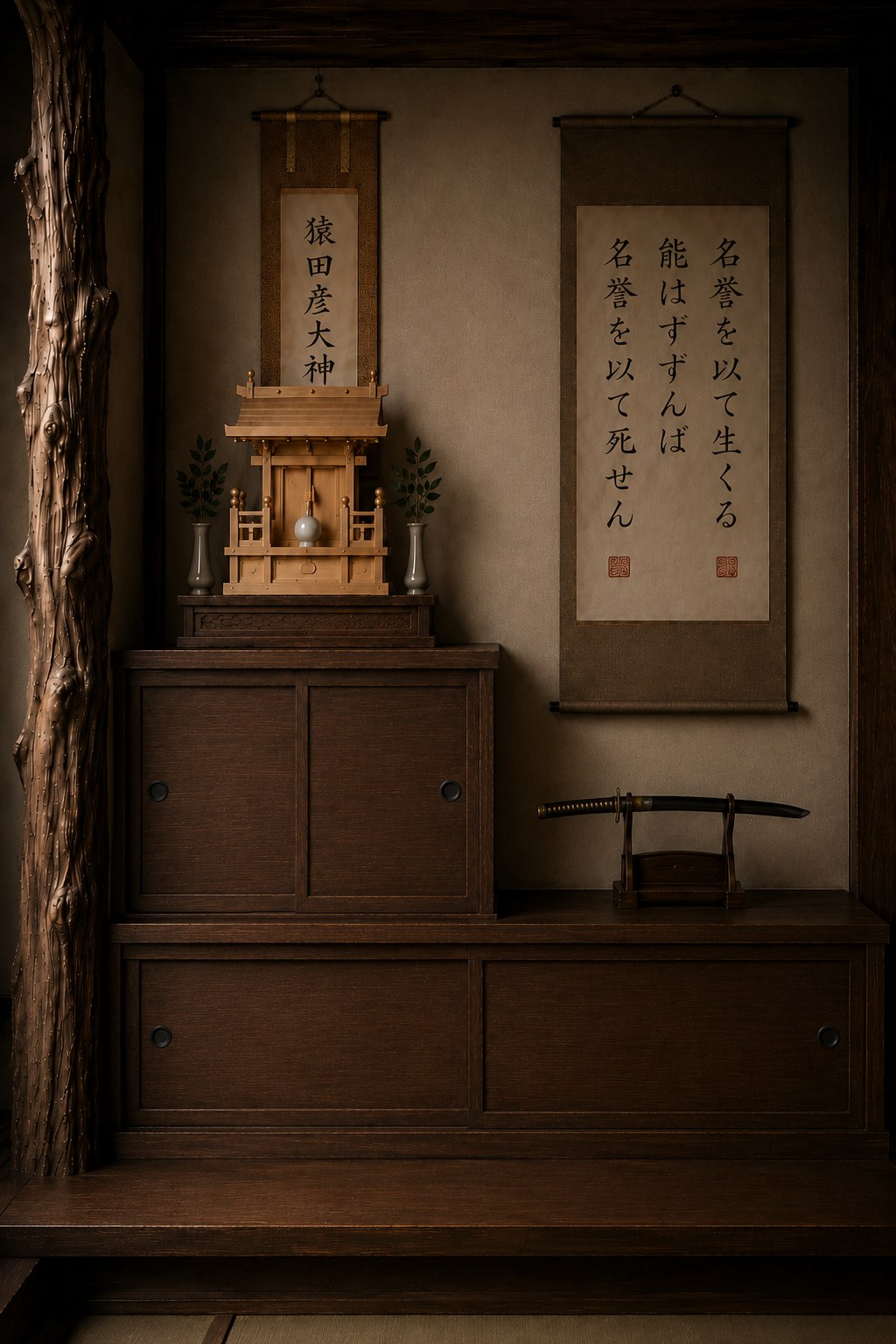
The orchestral prelude is short, but in it the audience first experience the stage space of this production. It is one space that becomes many: opening through a series of doors. Beyond the outermost door is the outside world, then the garden, the living room and finally, the bedroom. Suzuki and the servants set up the house. On the high place of the alcove on the left of the stage they place the household shrine. Behind it they hang a scroll with the name of the God. On the right they hang the family’s scroll. A servant places the sword below the family’s scroll. At the bottom of the alcove is a low cupboard with sliding doors.

Goro and Pinkerton, an officer in the US Navy, come in through a gate into the garden, then through the garden door into the living room. The marriage broker Goro shows Pinkerton around. Pinkerton has his gun on his belt and carries a briefcase with whisky inside it. As they move through the doors one by one, the audience realises the structure of the house. This constant movement through the doors is also how the audience identifies the different rooms.

In Japanese culture, when you enter a house, you remove your shoes. Pinkerton does not know this. He walks into the living room with his shoes on. Behind him the servants follow on their knees, quietly wiping away his footprints. They bring him a pair of slippers to put over his shoes so that he does not dirty the floor. Pinkerton wears them and after that the servants no longer need to wipe the floor behind him.

Pinkerton looks around the house as if he were looking over a rental property. He has the sword removed and sets his own pistol where the sword had stood. A servant takes the briefcase he brought and sets it beside the alcove.

The shrine and tokonoma with a decorative sword
The same wall, the sword replaced by Pinkerton’s gun

Act I. Pinkerton and Sharpless

Act I. Pinkerton and Sharpless

Sharpless, the American consul, arrives. He has lived in Japan for a long time. Without being asked, or even thinking about it, he takes off his shoes at the threshold. A servant takes them. The difference between the two Americans is all there in their manners. One entered with his shoes on and was given slippers. The other takes his off at the threshold himself.

Servants bring drinks, a low table and cushions from beside the alcove. They start to set the place in the middle of the stage. But Pinkerton has them move it in front of the alcove. Confused, they do as he asks. Sharpless quietly slides his cushion out towards the middle of the stage — there is a household shrine in the alcove, so he avoids drinking in front of it. It is the behaviour of a man used to this country. Pinkerton watches and is thrown while Goro scolds the servants. They take the cushions away and bring two boxes instead. Sharpless tells them to place them in the middle of the stage, so the drinking table ends up well away from the alcove.

The servants lay the table with Japanese drinks. But Pinkerton sees this and goes over to the alcove. He takes milk punch from his briefcase and sets it on the shrine, then takes out the whisky as well. A servant rushes over and moves the bottle from the shrine to the table. Pinkerton offers Sharpless milk punch or whisky. The servants take away the Japanese bottles and Pinkerton’s briefcase. Suzuki comes back with a cushion and sits to one side of the living room. As they drink, Pinkerton raises a toast to the real American wife he will take one day. Suzuki, who is pretending not to listen, reacts in shock. That toast says that, in Pinkerton’s mind, this marriage is temporary. Sharpless listens in silence.

Then Cio-Cio arrives. She is fifteen and carries her father’s sword wrapped in cloth. It was a gift from the Emperor, given with an order for him to end his life. He followed that command and killed himself when the family fell into ruin. When everything else was sold, this was the one thing that was kept. Suzuki takes it from her and puts it in the low cupboard while above it Pinkerton’s gun occupies the higher place.

Act I. The wedding

Act I. The wedding

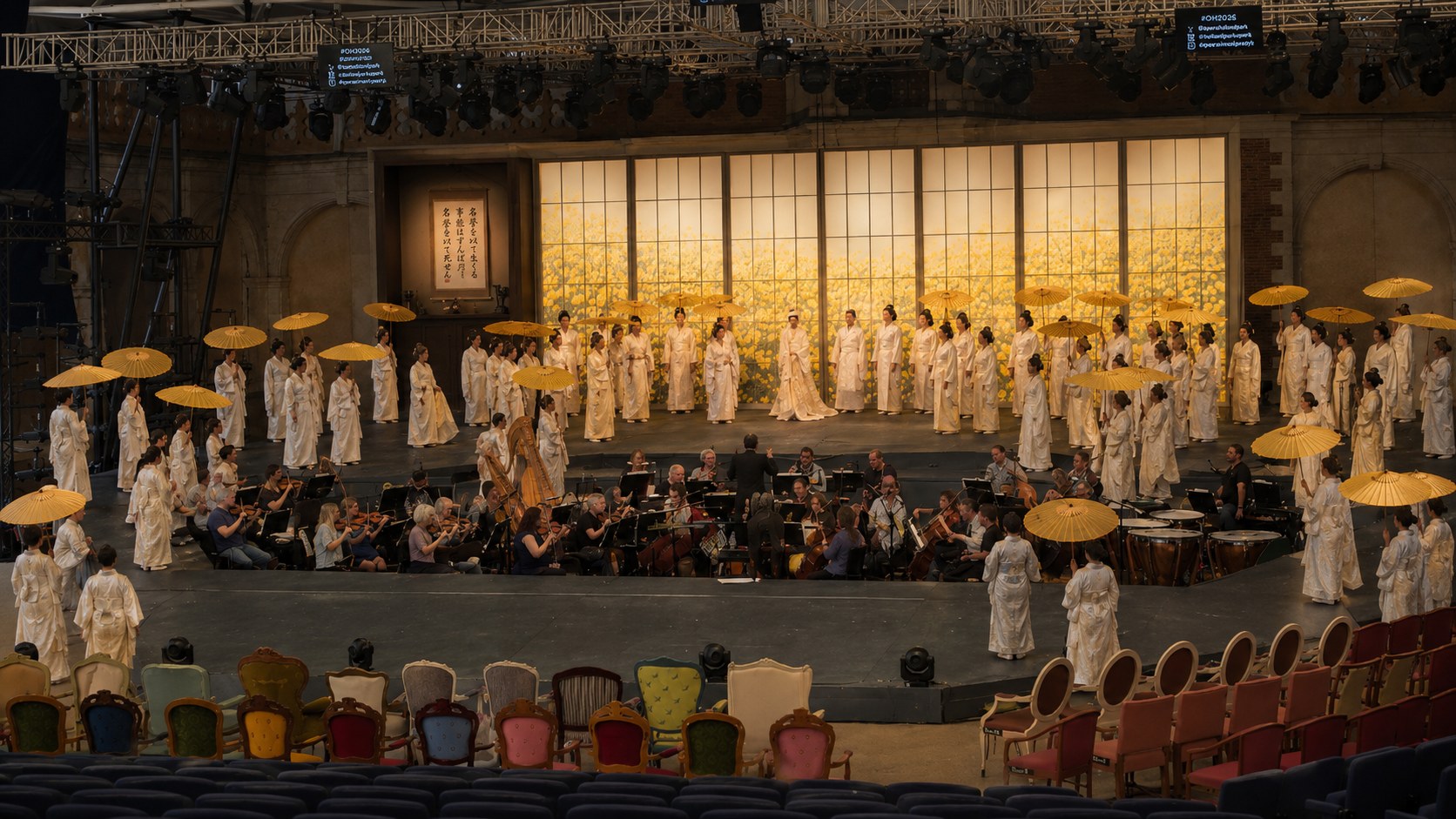
The Chorus enters wearing masks through the audience and as they do so remove them, smiling at everyone. Yellow parasols open, until the whole stage and auditorium become a field resembling dandelions. These are the bride’s people. On the groom’s side there are only a few Americans; Pinkerton’s fellow officers and sailors in uniform: a small foreign group at the edge of a Japanese crowd.

Behind this brightness and the smiles, the guests have not really come to celebrate. Inwardly they think that marrying an American is beneath her. To her face they compliment her, while judging the groom and whispering that he will soon leave her. This obvious, smiling hypocrisy is itself a kind of mask. Here the uncovered Japanese face is more of a mask than the covered one.

Once the marriage vows are made, her friends call her by the Western name the Americans have given her. ‘Madama Butterfly’, the title of the opera — and when it is spoken here by her own people, they laugh. Only for that moment of mockery do they lift the real masks to their faces and lower them again. They cover their faces at the one moment when their real feeling shows. And at the wedding of a bride who has converted, they call on their gods. O Kami, O Kami. The very gods she has rejected. Cio-Cio hears the laughter as a blessing. For her the vows have just made her an American wife and she puts on her own mask. The mask is the sign that she has become an American. From this point she behaves as she believes an American wife would.

Wedding: yellow parasols, chorus in white, the house as a field of dandelions

Act I. The curse

Act I. The curse

Cio-Cio’s uncle, Bonzo (the Bonze), arrives and curses the wedding — many productions read this as Bonzo cursing Cio-Cio, but I want to read it as a curse on this marriage and on the American man she is marrying, not on her. He says he knows Cio-Cio has been going to a Christian mission and has abandoned the gods of her ancestors. Cio-Cio believed no one knew of her religious conversion. Bonzo believes that in doing so she is trying to abandon her own people. But he also feels sorrow for Cio-Cio, directing his hostility towards Pinkerton.

The chorus put their masks back on and turn away. The same guests who were pretending to celebrate only a moment before now leave. That indifference is their truth. Pinkerton shouts at him, ‘Basta! Basta!’ The Americans who have been standing at the edge of the wedding step forward and point their guns at Bonzo. This is the change. A moment ago this was a Japanese gathering, now foreign soldiers are pointing Western weapons at a Japanese monk on Japanese ground. Bonzo steps back in front of the gun, as do the Japanese guests, with the whole group following the monk down the hill and leaving Cio-Cio with the Americans. It is not the curse that sends them away, it is the guns. The old faith does not retreat because it has lost an argument; rather it is threatened at gunpoint.

While every other face is behind a mask, Cio-Cio’s is the opposite. Her mask comes off, she doesn’t need to perform now. Cursed and cut off from her people, she now stands alone as herself, a bare-faced Japanese girl. When the stage finally empties, three people remain: Cio-Cio, Pinkerton and Suzuki, the only Japanese who does not leave her.

Pinkerton points a gun at Bonzo

Act I. Love duet

Act I. Love duet

This has the most beautiful music in the opera and is where the production presents its most painful image. It is also the only scene outside Suzuki’s memory. Everything else in the opera is something she witnessed; but not this. It is the first night of the marriage, the night Dolore is conceived and she cannot be in that room. Although she may have heard something through the wall, that is not the same.

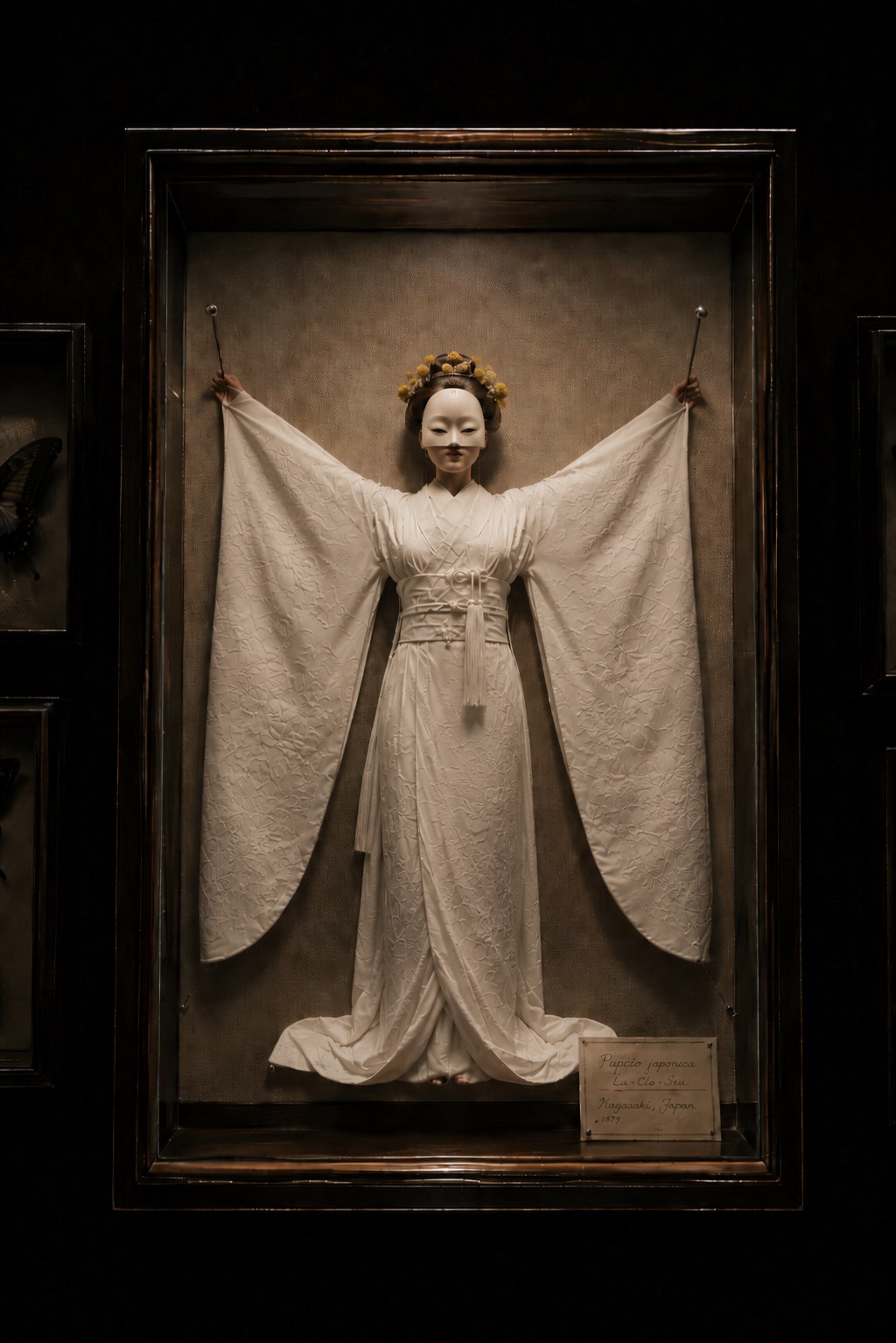
Suzuki may be telling her story, but as this is the one scene she did not see it can’t be shown through her eyes, nor through Cio-Cio’s or Pinkerton’s. Instead the production shows the moment as an image of its own. This scene is known as the love duet, but the image here is not a loving one. The girl is pinned like a specimen. The beauty of the music does not make the image softer, it makes it sharper.

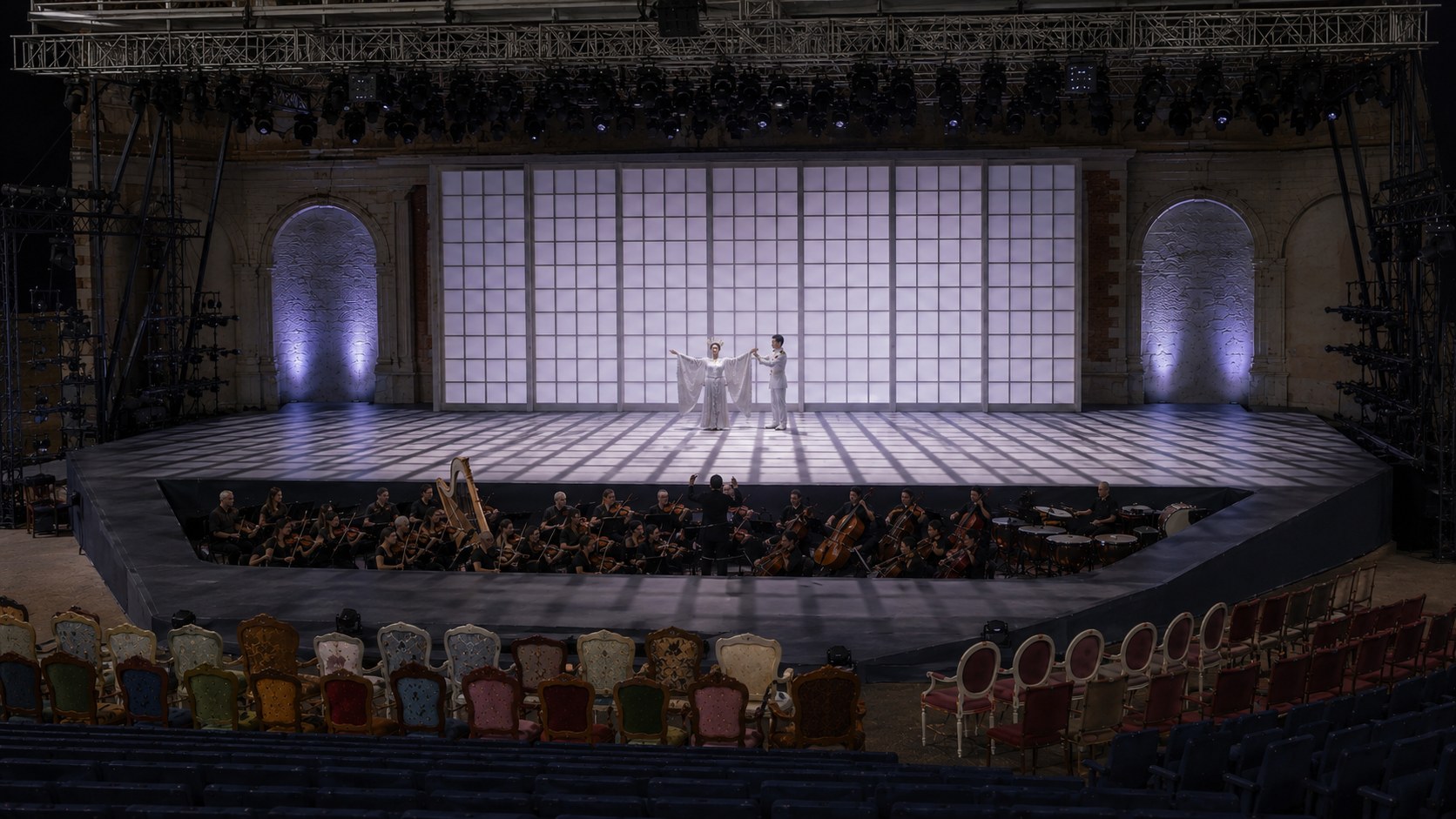
Light from the wall casts a grid of shadows across the floor and over their white clothes. The whole stage becomes the mesh of a net. Pinkerton calls her a butterfly: ‘Mia Butterfly! come t’han ben nomata tenue farfalla’ — ‘My Butterfly, how well they named you, delicate butterfly.’ At those words she pulls her hands back and answers in fear. ‘Dicon che oltre mare se cade in man dell’uom, ed in tavola infitta!’ — ‘They say that across the sea, when a butterfly falls into a man’s hand, it is pinned to a board.’ Pinkerton smiles and answers. ‘Io t’ho ghermita. Ti serro palpitante. Sei mia.’ — ‘I have caught you. I hold you trembling. You are mine.’

And it is staged exactly like that, as a series of actions. He catches her, lets her go, touches and arranges her, as a collector handles a specimen and fixes it onto a board. Her arms are opened like wings and held there. She is turned and placed until she is in the position he wants.

Cio-Cio pinned in a specimen case
Love duet: grid light on the floor, Pinkerton arranging Cio-Cio

Act II. Three years later

Act II. Three years later

Three years have passed. During the short orchestral prelude, Cio-Cio changes into the Western clothes Suzuki has brought her and in return gives her the Japanese robe she was wearing. Suzuki folds them away, putting them in the cupboard beside her father’s sword.

Cio-Cio keeps wearing the Western clothes, even though a Japanese woman bound to a foreign man was called a rashamen. Despite that scorn Cio-Cio stands upright, sustained by one bright hope. The hope that Pinkerton will come back and she will be his real American wife. After all, she is a dandelion that even though trampled does not break. She changes not only her clothes but the way she moves for the rest of the act.

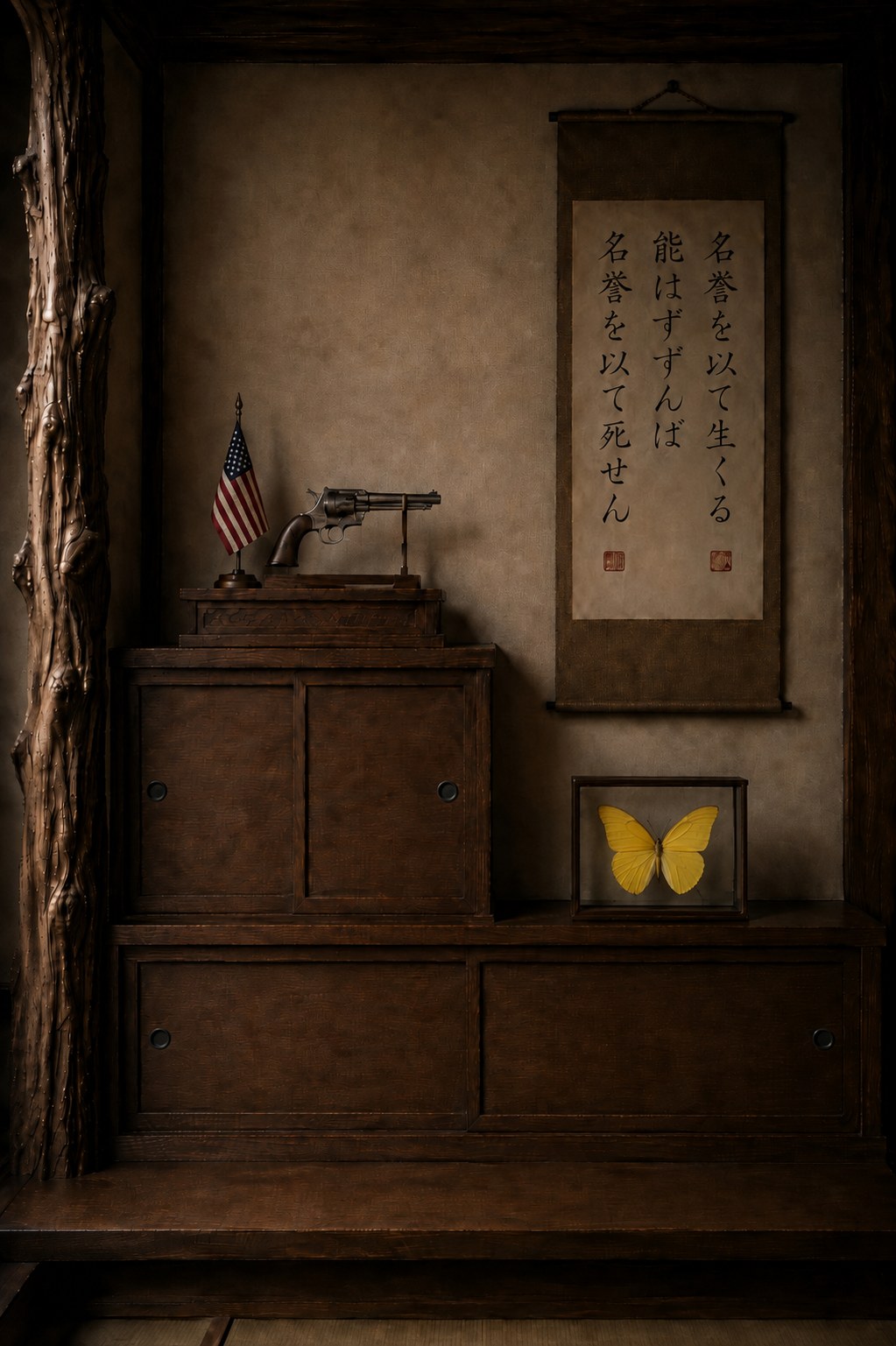
Cio-Cio has become an American wife, waiting for a husband who, despite leaving three years ago, has never written. Her ‘mask’ is now that she wears Western clothes and moves in a Western way. However this is all a performance. She is borrowing the clothes, the manners and the imitated devotion. The alcove remains the same as before but an American flag and a butterfly specimen case have been added.

After Suzuki puts Cio-Cio’s clothes in the cupboard she takes the gun and flag down to the floor. Kneeling on a cushion in front of the shrine she prays to the gods of Japan, asking them to keep Cio-Cio from crying. When the prayer ends Cio-Cio says the gods of Japan are lazy. She lifts the shrine down into the cupboard underneath and takes the scroll of the god’s name, rolls it up and puts it in with the shrine. Then she sets the gun and the American flag on the high place where the shrine stood. Cio-Cio places her mask there alongside the gun.

Director’s noteI would like her actually to wear the mask through the act, but that is difficult in practice, so this action stands for her wearing it.

The shrine still in place; gun, flag and specimen below
The shrine taken down; gun and flag on the high place

Act II. Un bel dì

Cio-Cio’s aria describes in detail the day Pinkerton’s ship will return. A line of smoke on the distant horizon, the white ship coming into the harbour, the man walking up the hill, the names he will call her. She is not remembering something that happened. She is teaching Suzuki, and herself, exactly how it will happen. This is the most famous music in the opera and Cio-Cio sings it with complete certainty to Suzuki, who now does not believe a word of it.

Director’s noteWe now know who Cio-Cio is. The singer performing this knows it too. For this one aria I want to leave the movement unplanned and let the singer express it in their own way. If until now the singer has worn a mask the director placed on them, this is the one moment when they can step out of that mask and simply be themselves.

Act II. Sharpless

Sharpless comes to read her a letter from Pinkerton, but every time he begins, her excitement runs ahead of his words and he cannot get even the first line out.

Suzuki starts to wait on them, but Cio-Cio stops her and serves Sharpless herself. In the way she offers him a cigarette, kneeling and bowing low, holding it out with both hands even in her Western clothes, she can’t help behaving the way she was raised.

Goro keeps appearing and disappearing through the door between the garden and the living room, watching and listening for a moment when he can interrupt.

Act II. Yamadori

Act II. Yamadori

Goro has arranged a marriage for Cio-Cio with the wealthy Yamadori, who has already arrived in the garden. His servants follow him only as far as the garden and stay there. He is wearing Western clothes, which in the Japan of this time is a mark of wealth and success. However, he walks awkwardly: in geta, held by a thong between the toes, his steps are short, but in Western shoes that hold the whole foot, he walks faster and takes longer steps than his servants. The same distance, but a different number of steps. His wealth is also shown by his pocket watch on a gold chain. He looks at the time, ironically in front of a woman who has waited three years for her husband to return. Meanwhile his servants are standing in the garden carrying gift boxes in their arms.

Yamadori comes into the living room and encounters a problem when he has to sit down. Western trousers are cut for a body that stands or sits on a chair, not for a body kneeling on the floor. He gathers the trousers up around his knees like a skirt before he can lower himself. He ends up lowering himself awkwardly and rather comically into a Japanese way of sitting. When he moves, the suit gives him an advantage. When he stops, these clothes do not sit well on a Japanese floor.

Goro is in the doorway. He goes between the garden and the living room, slipping through the sliding doors and moving between the two men and Cio-Cio, like a broker trying to manage all sides. Cio-Cio receives Yamadori with perfect politeness but refuses the offer: she belongs to Pinkerton, and she is committed to her new life as an American wife. By her new law she is a married woman and she will not hear anything different. Yamadori leaves. The servants who were waiting in the garden pick up the gift boxes and follow him out. Goro remains in the garden.

Yamadori kneeling in a Western suit, gathering the trousers at the knees

Act II. The letter and the child

Act II. The letter and the child

Now Sharpless and Cio-Cio are in the living room, with Suzuki waiting in a corner. At last he takes out the letter. ‘Now, just the two of us,’ he says, and sitting beside her starts to read the letter from the beginning. Each time he pauses, her happiness runs ahead of the words. He never reaches the important part: Pinkerton is returning to Japan, but not to her.

He gently asks what she would do if Pinkerton never came back. Cio-Cio has Suzuki bring the child out from the bedroom. Pinkerton’s son, whose existence Sharpless is completely unaware of. She introduces the child. ‘Oggi il mio nome è Dolore. Però dite al babbo, scrivendogli, che il giorno del suo ritorno, Gioia, Gioia mi chiamerò’ — today my name is Dolore, sorrow, but on the day my father returns I will be called Gioia, joy. In this production his name stays as Sorrow forever. Cio-Cio asks Sharpless to write to Pinkerton and tell him that his son is waiting.

Suzuki has gone out to Goro in the garden and, after saying her farewell to Sharpless, she returns to the living room. Goro is telling her something and she stops, changing her mind. Taking Goro by the back of the neck she drags him into the house.

Goro corrects what Suzuki said. ‘Dicevo… solo… che là in America quando un figliolo è nato maledetto trarrà sempre reietto la vita fra le genti!’ — I only said that over there in America, when a child is born cursed (mixed-race, as this opera means it), it will be rejected for life. He is, of course, telling the truth.

Director’s noteThis is why Suzuki resolves the child must not be taken to America.

Cio-Cio reacts, accusing Goro of lying. She says it first to herself, refusing what she knows is true. Only the last cry is turned on Goro, throwing the truth back at him to shut it out. Cio-Cio runs to the tokonoma, takes the gun that stands there and levels it at Goro. She drives him out of the room and he flees in fear.

Act II. Flower duet

Act II. Flower duet

A cannon sounds from the harbour. Pinkerton’s ship has arrived. Cio-Cio and Suzuki decorate the house with flowers to welcome him home.

Director’s noteThere are no real flowers on the stage, only light. Suzuki comes out with both arms full, exactly as the score asks. The two women scatter flowers with their bodies moving in the rhythm of the dance. But their hands are empty. The audience sees the movement, not the flowers. Instead the light changes. The whole stage fills with colour, white and violet, until the fragrance she sings about has become light and the empty stage feels as if it is covered in flowers. It is not the yellow of the wedding.

Flower duet: two women, empty hands, white and violet light

Act II. The night vigil

Act II. The night vigil

Night falls and the colour leaves the stage. To welcome Pinkerton, Cio-Cio wants to change into her wedding clothes. Suzuki goes to the cupboard to take out the Japanese robe.

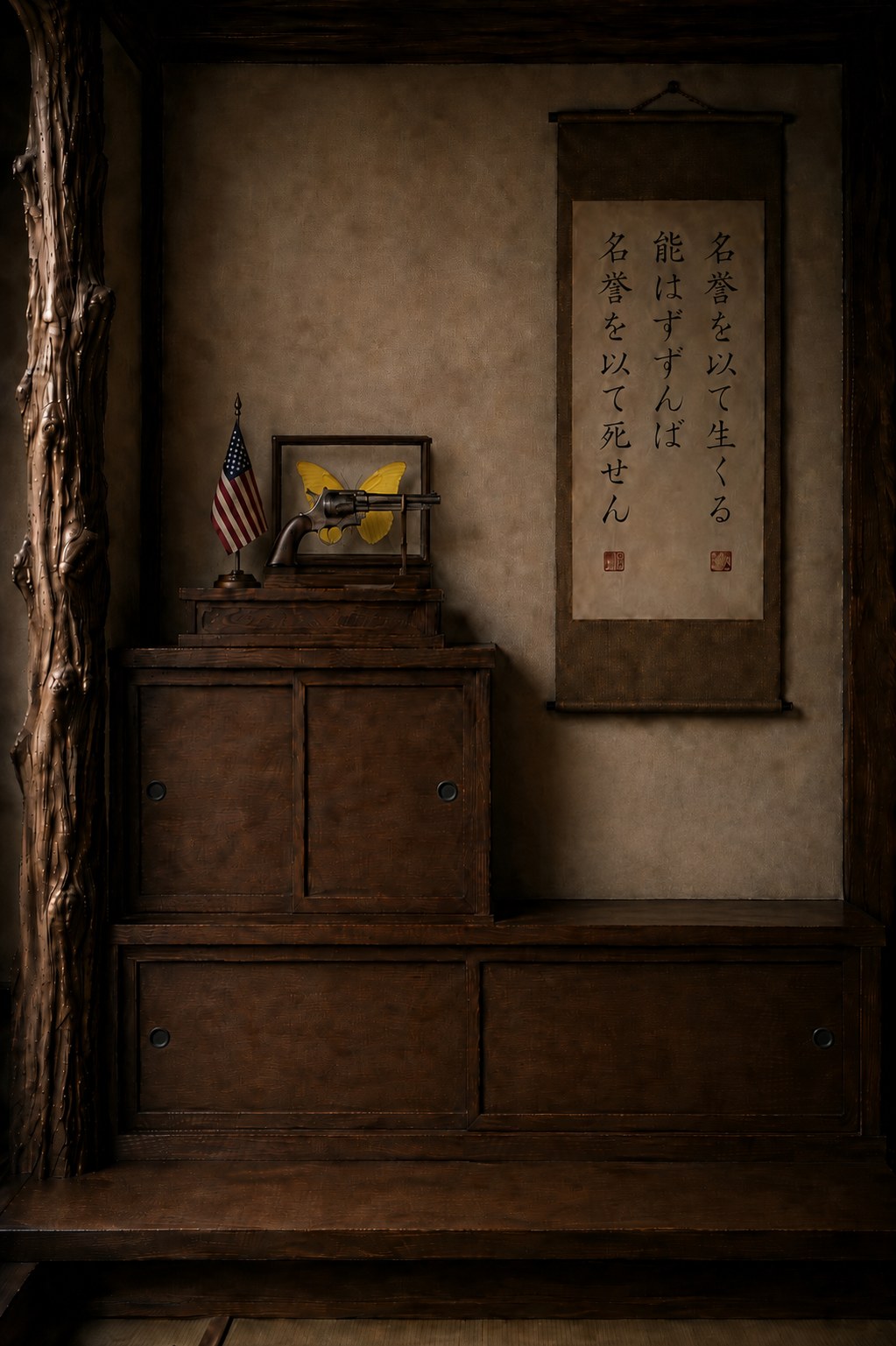
As Suzuki is taking out the robe, Dolore follows her and picks up the butterfly specimen case from the alcove. Suzuki takes it from him and puts it up beside the gun. The child throws a tantrum for it, clinging to Suzuki and refusing to let go. Trying to calm him, Cio-Cio never manages to change her clothes. The child cries himself out and at last falls asleep at her feet. Suzuki puts the Japanese robe back into the cupboard.

The wordless humming chorus begins, not from the stage but from behind the audience, so the sound comes from all around, surrounding the auditorium. Worn out by Dolore, Cio-Cio sits beside him as he sleeps.

Director’s noteIn the original this scene has Cio-Cio waiting all night, still as a statue. The music is at its most peaceful, all the way through the humming chorus. In this production the staging is actually the opposite of stillness. What you hear is calm, but what you see is a mother worn out by her child. Dolore’s commotion runs on even inside the quiet of the humming chorus. Instead of a sublime woman standing through the night, we see a tired mother sitting beside her tired-out child.

Night: gun, flag and specimen on the high place where the shrine stood

Act III. Dawn and Pinkerton’s return

The night passes and morning comes. Cio-Cio picks up the child and carries him into the bedroom. Suzuki is left alone in the living room. Pinkerton, Sharpless and Kate enter the garden and knock on the door. Suzuki opens it and finds Pinkerton and Sharpless. The two men come into the living room but the woman, Kate, Pinkerton’s wife, stays in the garden. The door is left open so she is not backstage; rather she’s on our stage, watching everything through that open door and reacting to it.

In the garden Suzuki sees an unfamiliar woman and realises she is Pinkerton’s wife. Through the subsequent trio, while the two men avoid saying what must be said, she presses them, breaks down, gets up again and refuses. Suzuki has to dominate here. Pinkerton goes to the bedroom door, opens it slightly and looks at the sleeping Cio-Cio and the child. Then, having closed it, he sings his farewell to the house. ‘Farewell, flowering refuge.’

He leaves money with Sharpless, saying he cannot stay any longer, and quickly leaves the house. Kate sees him coming out into the garden but slips away, pretending she has neither seen nor heard any of it, and Pinkerton goes without even knowing she is there.

Act III. Kate

Kate stays in the garden and quietly asks Suzuki whether she will tell Cio-Cio what has happened, and says she will raise the child as her own. Suzuki bows her head and promises, then says that at this moment she needs to be alone with Cio-Cio.

Cio-Cio calls Suzuki from the bedroom. Kate moves back into the garden so that she cannot be seen. Cio-Cio comes into the living room believing Pinkerton has arrived and looks around for him. He is not there. Then Cio-Cio notices the woman out in the garden and realises who she is.

Cio-Cio says, ‘If he comes for the child himself, I will let him take the child. Tell him to come up the hill in half an hour.’ Kate and Sharpless leave. Cio-Cio is left alone, falls to the ground in tears, and Suzuki runs to help her.

Director’s noteKate enters wearing violet, the colour Cio-Cio filled the stage with while waiting for Pinkerton.

Act III. The end

Act III. The end

Cio-Cio tells Suzuki to check on the child and take him outside to play. Suzuki brings the child from the bedroom to the door space (the audience has not seen them go out into the garden, so this space reads as the garden) and secretly watches what Cio-Cio does.

Director’s noteThe young adult Dolore returns to the cushion he sat on during the Prologue. There’s a second cushion for Suzuki, who will come and sit there later. The lighting is set so that the audience does not see him come in and sit. Only once he is in place does the light come up on him. From this moment the grown Dolore is watching this scene of his mother’s death.

Cio-Cio goes to the alcove and reads aloud what is written there. The Japanese scroll that has hung there throughout is revealed and for the first time the audience hears what it means. ‘If you cannot live with honour, die with honour.’

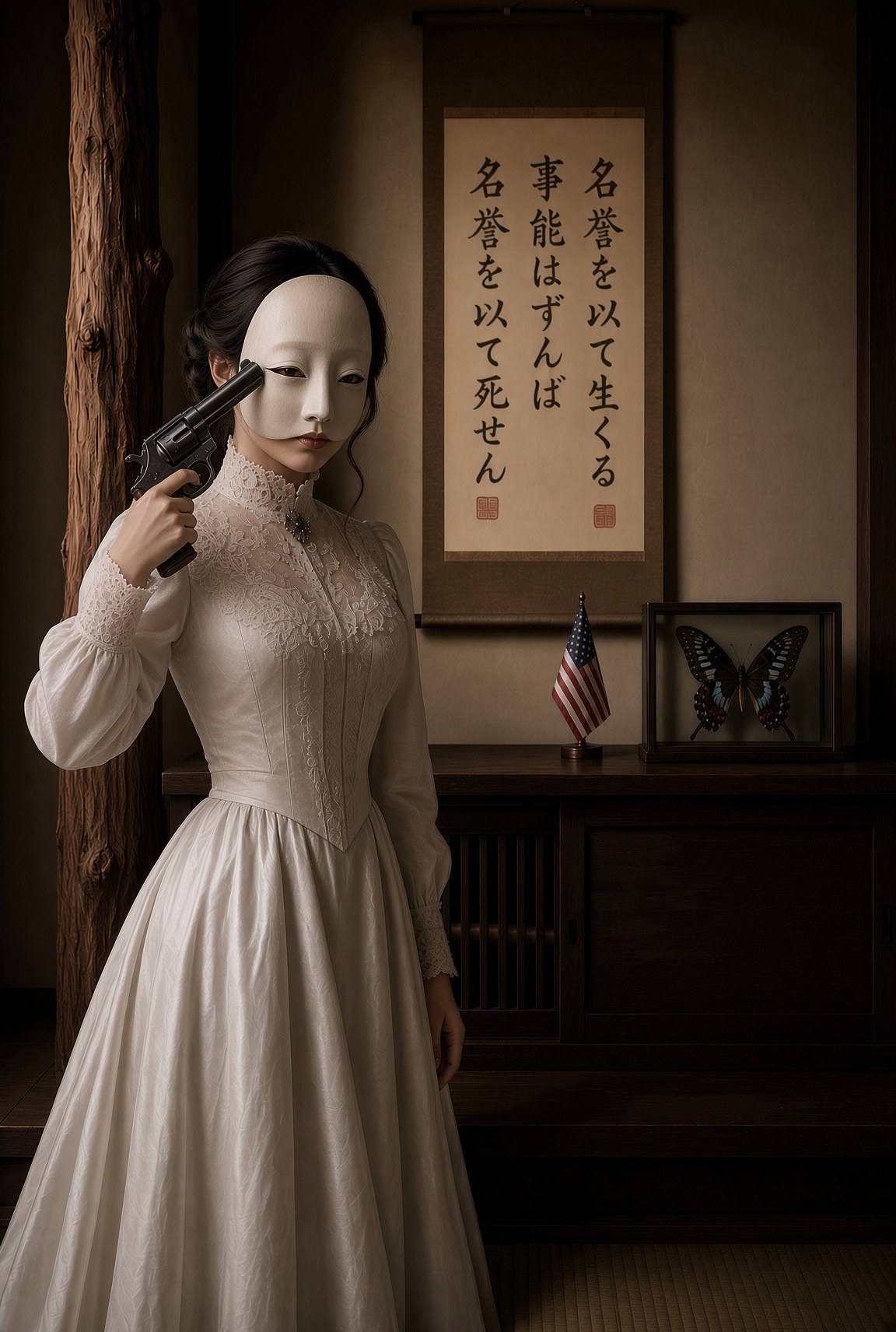
She puts on the mask that was beside the gun, which she then takes. After three years of living her life as if in the West, she is about to end her life in a Western way too. She puts the gun to her temple. The hand holding it will not stop shaking.

Suzuki pushes the child in through the open garden door. He runs in. Cio-Cio lowers the gun and gives him the American flag and the butterfly specimen he wanted the previous night. The child becomes completely absorbed in playing with it.

Here, an honourable death is not the Western gun but the Japanese sword, her father’s sword hidden inside the cloth. She tears through the cupboard for it. Only when the sword is in her hand does she become calm. She lifts the Japanese robe that comes out with the sword and puts it over her Western clothes. After living three years as a Westerner she has one last outer layer to add and it is a Japanese one.

Cio-Cio takes off the mask, removing three years as an American wife, and puts it in the alcove beside the gun. Now bare-faced and back to her own roots, she goes into her room and the door closes. The child is lost in his playing and the specimen breaks in his hands.

Cio-Cio in Western dress, mask in one hand, gun in the other
Cio-Cio goes into her room with the sword; the child with the broken specimen; a dandelion seedhead on the wall

Ending

Ending

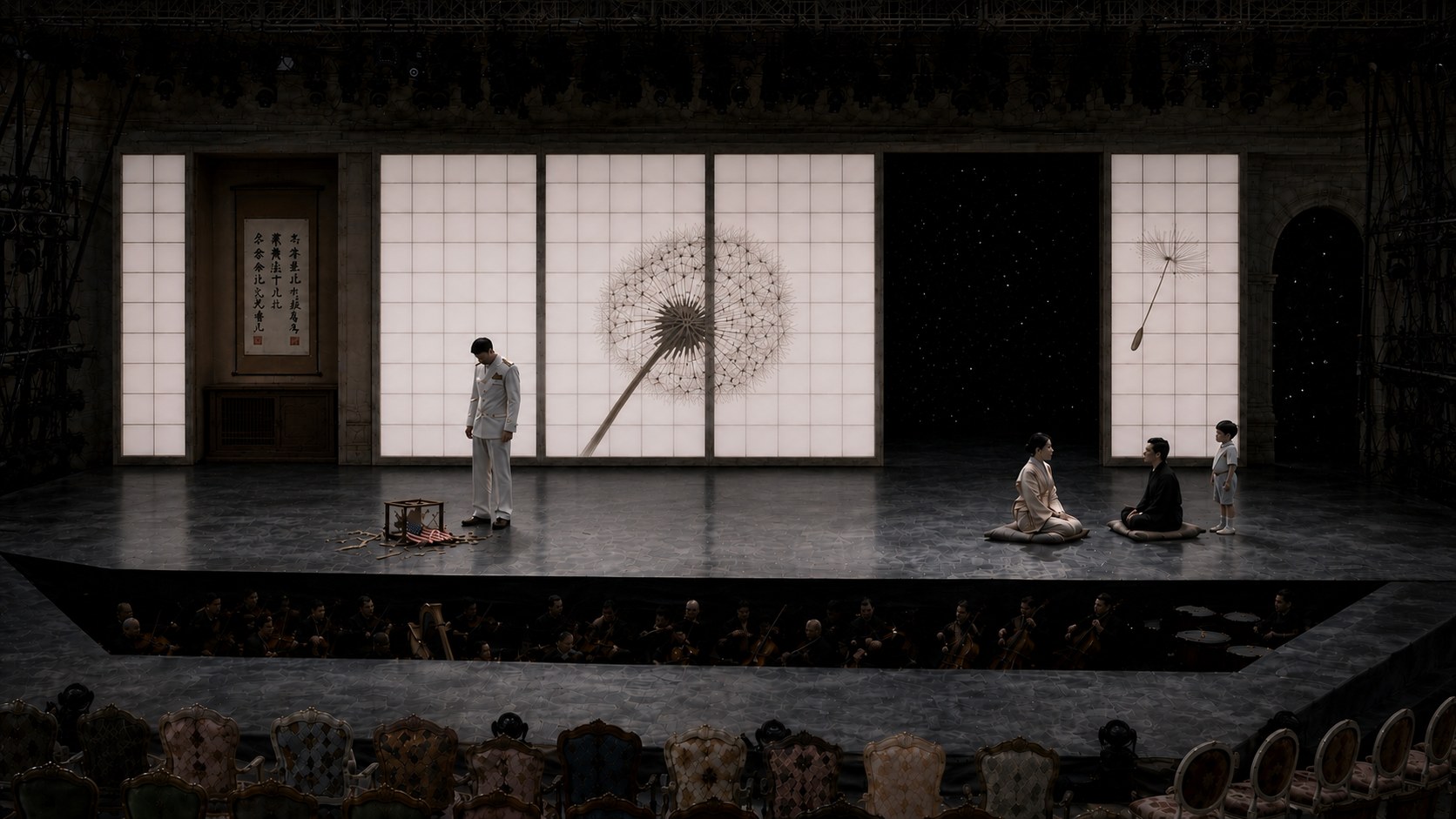
After she pushes the child into the house, Suzuki goes out into the garden, where she sinks to the ground. Pinkerton arrives and goes into the living room. Suzuki follows him in. On the wall the dandelion seed head is perfect. Poised to release its seeds.

Pinkerton goes straight to Dolore, but the child is afraid of this stranger, whom he is seeing for the first time, and goes to Suzuki. Suzuki takes the child by the hand and goes to where the young adult Dolore is sitting. She sits down in the same place she took in the prologue. The young and older Dolore are together. On the screen one drifting dandelion seed reaches both of them, the child and the adult.

Meanwhile Pinkerton is alone. He stands over the American flag and the broken glass case on the floor and cries out towards the dead woman. ‘Butterfly’, the final cry of the opera. Pinkerton’s cry and the cry that opened the prologue now sound together — as the two anthems did at the start.

Pinkerton alone over the flag; Suzuki, grown Dolore and the child; a seed drifting on the wall
04 — How It's Made I

The Set

The whole house is a single wall of six tall panels. There is no other scenery. Space is not a zone of the stage. It is decided by which door you came through — and that space travels with you.

Six doors

A wall of six tall panels runs across the back of the stage. They are shoji, the Japanese sliding door. Each one opens.

The door is about to open.

1

Hinged on 2 · outside ↔ garden

2 · 4

Sliding pair · garden ↔ living room

3 · 5

Stack behind 4 · living room ↔ room

6

Tokonoma · marks the living room

5 doors

You cannot get from the inner room to outside the house in one step. As in a real house, you pass through, in order: garden, living room, room.

In a real house one doorway is a single thing. Here it is a pair: one door to leave by, one to enter by. Pass through both, exit and return, and you have changed space. Leave through only one, off the stage, and you stay in the space that door belongs to.

The 6th door

The alcove sits behind door 6; opening and closing that door makes it appear and disappear. On one side is the kamidana, a household Shinto altar, its scroll naming the god Sarutahiko Ōkami — ‘Kami Sarundasico’ in the libretto. On the other is the tokonoma, a formal display space, its scroll reading If one cannot live with honour, one dies with honour — the words Cio-Cio reads at the very end of the opera. Below is a low Japanese cupboard. Into it go the father’s sword Cio-Cio brings with her and the Japanese robe she takes off at the start of Act II. In Act II she shoves the kamidana in here too, clearing its place for the American flag and gun.

Behind door 6: tokonoma with the decorative sword
05 — How It's Made II

The Mask

Hide your face, hide your truth

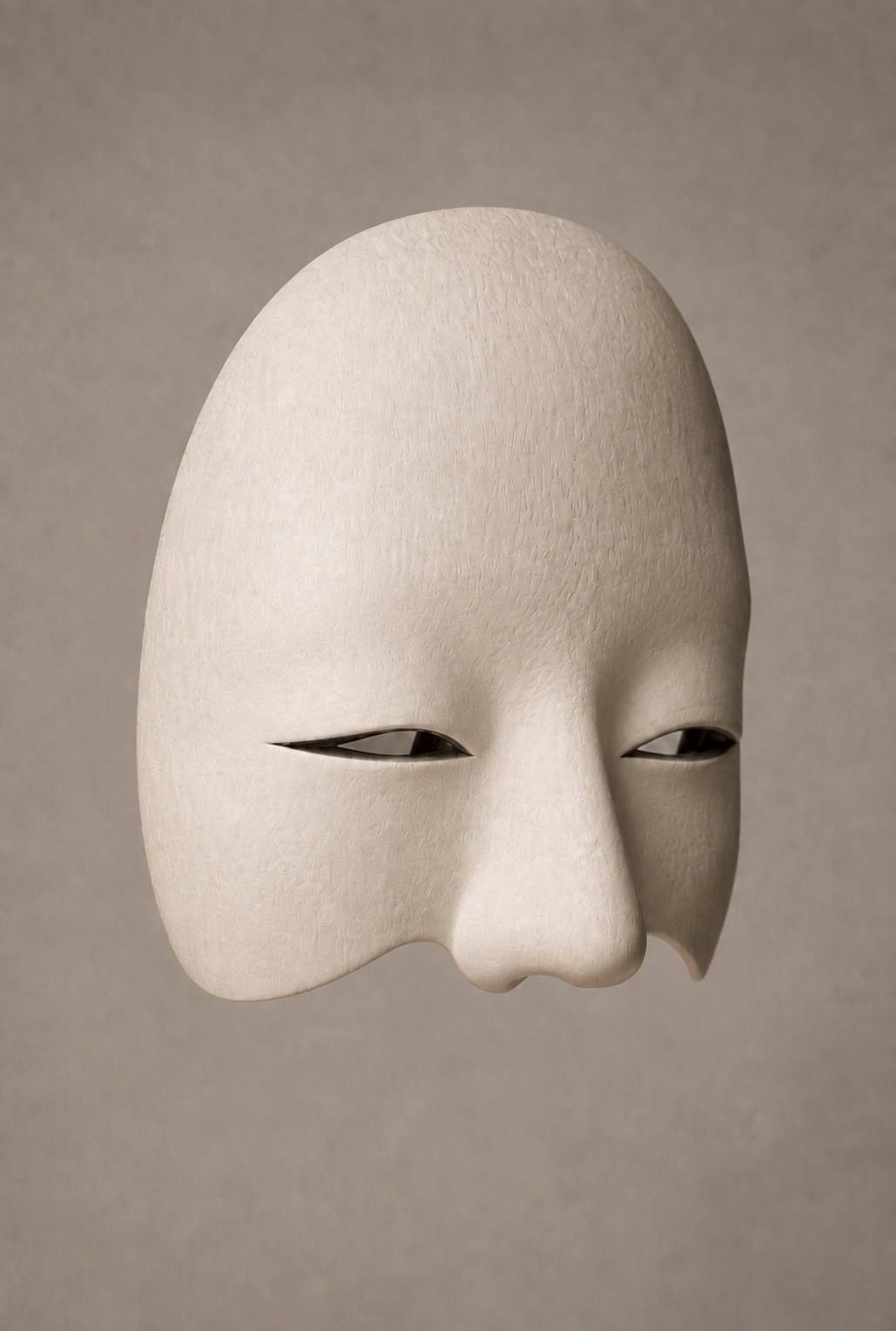
White Noh half-mask

The masks are white, chosen from Noh, one of Japan’s traditional theatre masks. Ours are half-masks, covering the upper face only. They conceal the emotions that would normally appear on a singer’s face, directing the audience’s attention toward movement.

Movement

How one walks, sits and greets

When people think of Madama Butterfly, and of Japanese movement, they think of movements that come from kabuki theatre. But those are the classical stage conventions of a theatrical genre, not the movements of daily life shaped by Japanese history.

What I want to show is why the movements of Japanese daily life are different. People sit on the floor, kneel, take off their shoes indoors, bow from the waist. A door is opened on one’s knees. Japanese footwear makes the stride a different length.

Projection

The dandelion on the wall

A dandelion runs on the shoji wall from beginning to end, moving across the panels as the doors open and close. So whatever happens on stage, the flower is always on the wall.

It grows. Blooming, closing, going to seed — a slow change across the whole opera, always underneath, like a bass line.

Sometimes a single dandelion, sometimes a million filling the wall. At the wedding, the dandelion reaches its peak: a field in full bloom appears across the whole wall. Just before Cio-Cio’s death, it comes to its other peak. At the very end, the seeds fly.

In one scene only, the flower duet, the dandelion disappears. The stage fills with purple and white — the colour of what she waits for, which was never hers. Only later, when Kate walks in, do we see whose colour it was.

Dandelion

Who Cio-Cio really is

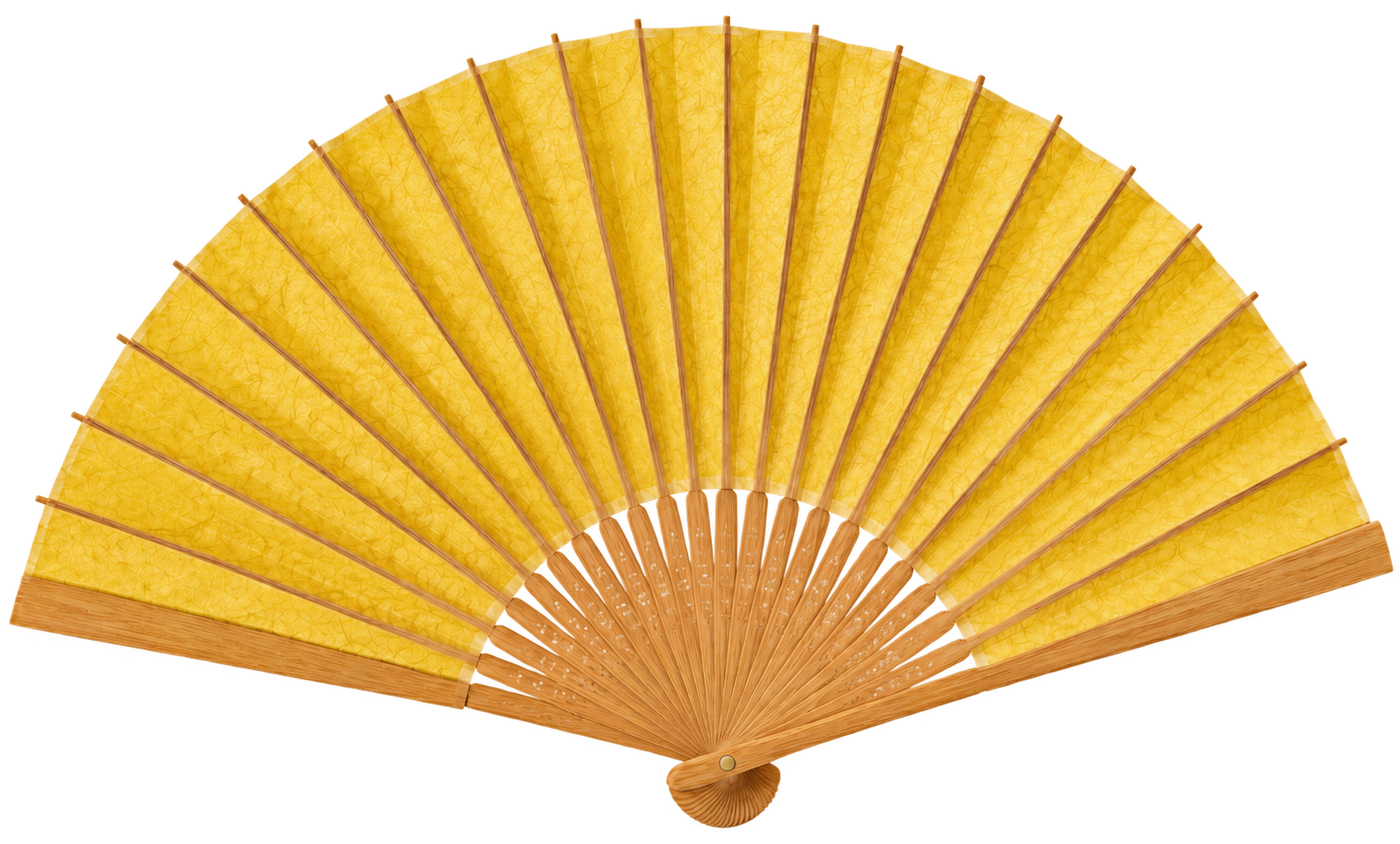
Yellow folding fan
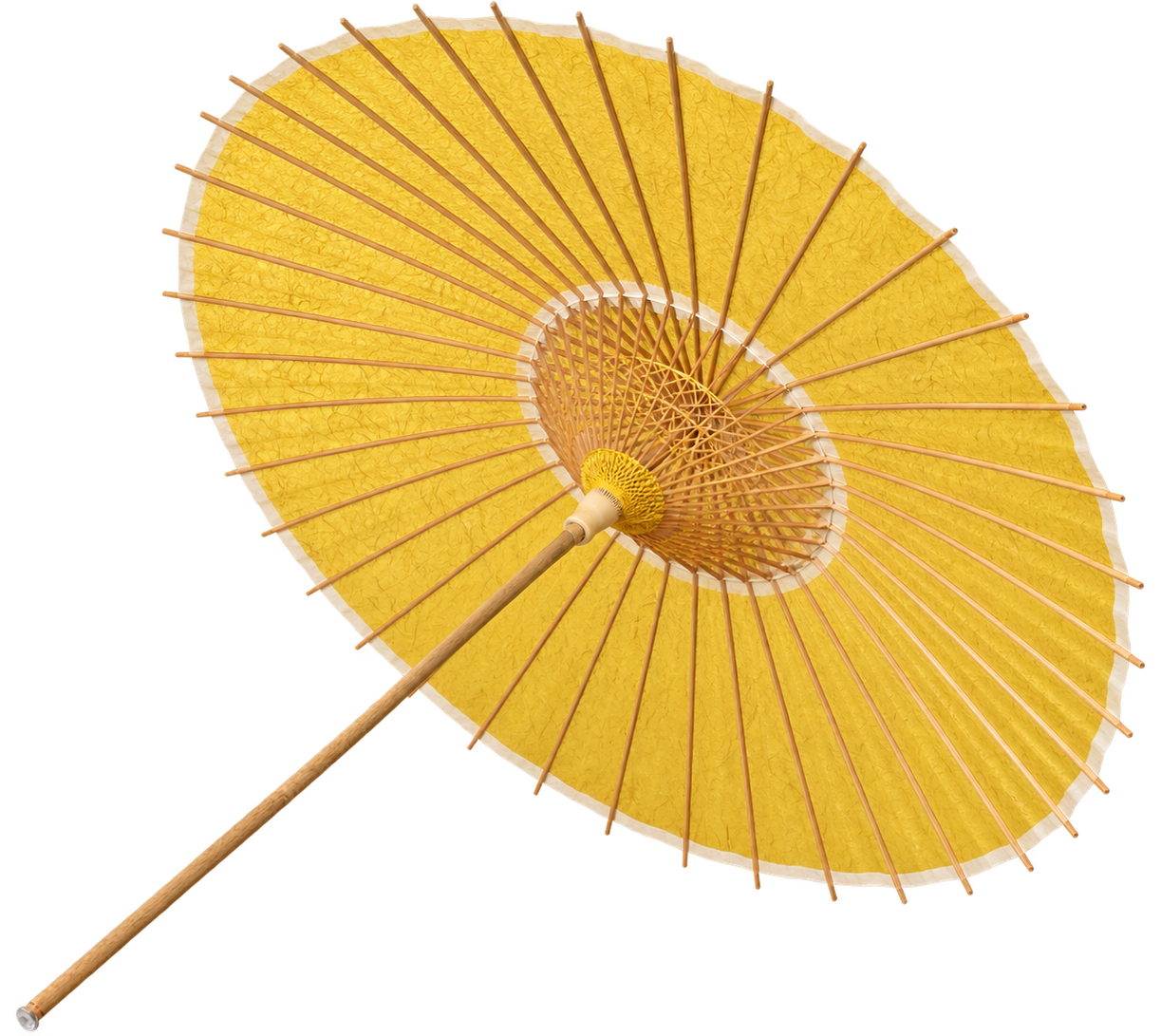
Yellow Japanese parasol
Yellow butterfly in a specimen case
06 — How It's Made III

Costume

Wear, can be worn

Some costumes are kept white and pale, high in brightness and low in saturation, so that projection or light falling on them changes their colour, and to suggest the dandelion.

Cio-Cio-San
Suzuki
Pinkerton
Sharpless
Yamadori
Goro
Bonzo
Kate
Act I servant
Yamadori’s servant
Dolore, 17
Dolore, 3
Chorus I
Chorus II
Chorus III
07 — Why II

History, then the stage

Homework first

Kido wo iro ni arawasazu

In Nitobe’s Bushido (1899), written for Western readers in Cio-Cio-San’s own time, the samurai ideal of self-control (克己, kokki) held that it was unmanly to betray one’s emotions on the face. “Kido wo iro ni arawasazu” — to show neither joy nor anger — was a phrase used in praise of a great character. Children were brought up not to show a tear or a groan: this was not a nature but a training.

This was not an absence of feeling. Nitobe insists the Japanese are as susceptible to tender emotion as any race under the sky, and that it was their very sensitiveness that made self-restraint necessary.

A Japanese friend in deepest grief, he writes, will receive you laughing. Laughter veils an effort to regain balance of temper — a counterpoise of sorrow or rage.

Nitobe, Bushido Samurai StyleEN

Rashamen

Rashamen was a derogatory term for a Japanese woman who became the mistress or the local wife of a foreigner.

The word originally meant a sheep — the kind raised for the wool (rasha) that made Western cloth.

Westerners brought dogs into their rooms and even let them lie in their bedchambers. The people mistakenly believed that Westerners — whom the Japanese regarded as barbarians outside civilization (洋夷, yōi) — had sex with dogs and sheep. Counting a maiden who became such a man’s concubine (夷妾) as no different from those dogs and sheep, they scorned her; menial workers gave her the nickname, and began to call her rashamen.

JB PressEN Kotobank『らしゃめん』EN

Ainoko

Ainoko was a derogatory term for a child of mixed parentage, a Eurasian.

Though it sounds like “child of love,” that reading is a mistake; the kanji for love is a different character. The word has instead been linked to the phrase “son of error.”

Those who held to a belief in racial purity regarded the ainoko as not a pure Japanese. It marked the child as not fully belonging to Japan.

Around 1900, in the treaty ports, Eurasian children were insulated from mainstream Japanese society and sent to international schools, yet were not fully accepted within the foreign community either. They belonged wholly to neither side. More painfully, some came to regard their own mixed blood as a source of shame, and their families erased the mixed member from the record.
Wikipedia『ハーフ (混血)』EN Discover Nikkei USFCA Perspectives

Superior firepower

Western firepower forced these treaties, and as a result, Japan’s feudal leaders acknowledged the superior firepower of the foreigners and agreed to open the country to commerce, foreign residence, and diplomatic exchanges. This brought about many changes in Japan over time, but what I want to focus on here is Westernization.

For example, traditional kimono gave way to Western clothing; there were Western-style clothing and haircuts, the end of the samurai class, the abolition of the rigid class system of feudal Japan, and the Gregorian calendar replacing the traditional lunar calendar.

Even if Western pressure became the catalyst for Japan’s modernization, the Japanese pulled up their own roots with their own hands.

MIT Visualizing Cultures Artelino, Meiji period Japambience, Meiji Restoration Commodore Perry and the opening of Japan

Kamidana

A kamidana is a miniature Shinto altar kept high on the wall of a house, to enshrine a kami.

It takes the form of a small shrine building in unpainted natural wood, called a miyagata. Inside stands the shintai, the object in which the kami dwells — most often a small round mirror. Sprigs of sakaki, the sacred evergreen, are set on either side. Behind it hangs a scroll bearing the name of the enshrined kami — the whole alcove serving as the shrine.

Each day, offerings of water, rice, salt, and sake are set before it. Before worship the family cleanse their hands, then bow, clap, and pray for the safety and blessing of the household.

Wikipedia, kamidana Britannica KuboderaEN

Who are the geisha

Geisha are Japanese performing artists, trained for years in the arts — the shamisen, dance, song, tea, and conversation.

The line between a geisha and a licensed prostitute was a legal one. Prostitution was lawful with a licence, held by the courtesans; a geisha was strictly forbidden to hold one, and if she sold sex her house lost its licence.

What blurred that line was not Japan but the Western eye, which folded geisha, courtesan, and prostitute into a single purchasable figure.

Wikipedia, geisha Inside Japan Tours

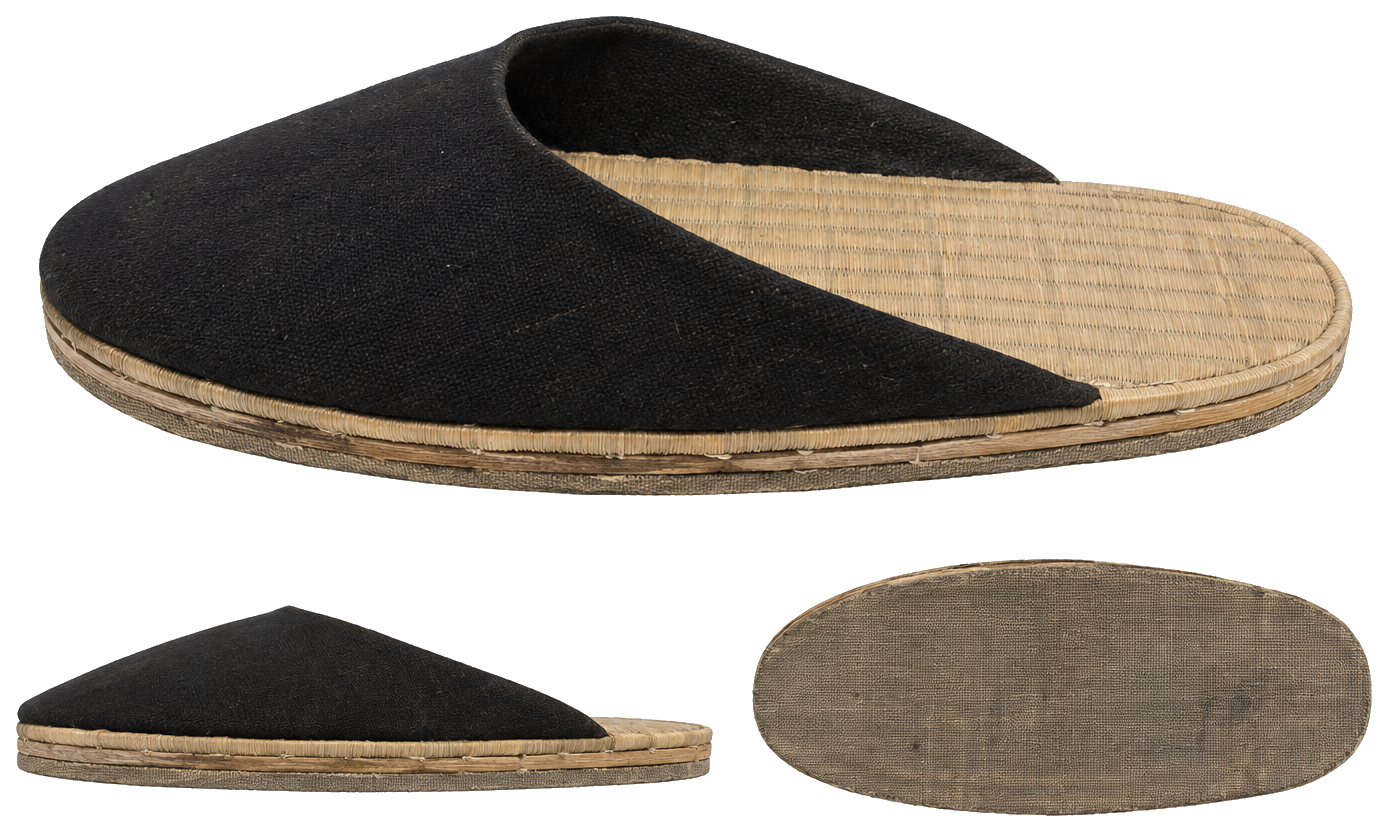
Surippa , slippers

Japan has an old custom of taking off one’s shoes before stepping into a house.

The slipper was invented for the foreigners who did not. After Japan opened, Westerners came who kept their shoes on indoors, walking onto the tatami and soiling it, because in the West one does not take off one’s shoes in front of others. To solve this, a tailor in Tokyo, Tokuno Toshisaburō, made a shoe cover to be worn over the shoes — the origin of the slipper. So the first slipper was a thing worn over Western shoes.

There are several accounts of where its name came from. But the Japanese surippa is not the English slipper; it refers to this particular overshoe.

By Cio-Cio-San’s time the slipper already existed, a thing brought out for a foreign guest.

Wikipedia『スリッパ』EN Nippon.com

Black fabric slippers with tatami soles, three views
08 — 1904

The 1904 première

What I see

The version performed almost everywhere today is not the one Puccini first wrote. After the 1904 première failed at La Scala, he cut and reshaped the opera into the form we now know. This production goes back to that first version.

01 — Act I

Pinkerton renames the servants “muzzles”

When Goro introduces the three servants, their names are small images from nature — Nuvola leggiera (light cloud), Raggio di sol nascente (ray of the rising sun), Esala aromi (breathing out fragrance). Pinkerton dismisses them as a joke and says he will just call them musi: in Italian, the plural of muso, an animal’s snout.

But to a Japanese ear the sound is 無地, muji — plain, blank, patternless, the word behind the brand MUJI. So he is not only calling them snouts; he is painting three colourful names over white, then numbering the blanks one by one: muso primo, secondo, terzo.

The chilling part is that Pinkerton only half understands himself — he cannot hear that the sound also erases their identity into blank paper. And muji is not ugly in Japanese: to strip away your own decoration is refinement, but to have your colour erased for you and be filed by number is violence.

02 — Act I

The insect dishes and “Nipponeria”

Pinkerton orders: “Qua i tre musi. Servite ragni e mosche candite. Nidi al giulebbe e quale è licor più indigesto e più nauseabonda leccornia della Nipponeria.” — Here, the three musi (snouts). Serve candied spiders and flies, nests in syrup, and whatever is the most indigestible and nauseating delicacy of Nipponeria.

Nipponeria — built on Nippon, the Japanese word for Japan — is the second Japanese-derived word here, after musi; together they confirm Illica used Japanese deliberately. It is usually read as a slur (“Jap stuff”), but the -eria suffix is neutral (as in pizzeria), and the word exists for a rhyme: leccornia della Nipponeria. The contempt is in Pinkerton calling the food nauseating, not in the word itself.

And the food is real — the servants fetch it because it is in the house. (The birds’-nest is a slip: that is Chinese, not Japanese, folded into “Japan” like Puccini’s music box playing Chinese tunes.) Pinkerton took real, everyday food and called it disgusting to his own palate. To my mind that “most nauseating delicacy” is nattō: sticky, pungent, threads stretching from the bowl, turning a foreign stomach while a Japanese one thinks nothing of it. It was ordinary working-class breakfast food by this period — so the vilest delicacy of all “Nipponeria,” in his mouth, is simply someone’s plain morning meal.

03 — Act I

Pinkerton, worn out by Japanese bows

A wedding is the most formal occasion Japan knows, and its etiquette descends from samurai ceremony — the very tradition Butterfly’s fallen samurai family still keeps. So her relatives greet Pinkerton with the full weight of that courtesy, and the courtesy keeps coming. Butterfly sees him and goes down — “F. B. Pinkerton. Giù.” (she kneels); her friends fold their parasols and go down with her. Then the relatives come forward and bow deeply, once — “Facciamo un inchino profondo” — and Pinkerton returns it. They bow a second time, and he answers again: “La stessa moneta vi do” (I give you the same coin). They bow a third time. And here he protests: “Ammiro la vostra costanza, ma il dorso curvar più non so.” — I admire your persistence, but I no longer know how to bend my back.

But he does not actually stop — he grumbles, and the greeting goes on anyway: each relative introduced in turn, and at last the whole party prostrating itself at once (tutti si prosternano). This exchange is cut from the standard version; the worn-out Pinkerton exists only in 1904. And it is not that three bows have tired his back — he is a foreigner, and the rule is that when someone bows to you, you bow back, in the same manner. So the bowing never stops.

04 — Act I

The wedding drinking scene

The marriage is already signed. The Commissioner has read the contract, Pinkerton and Butterfly have signed, she has corrected the friends’ “Madama Butterfly” to “Madama F. B. Pinkerton,” and the officials have left. The formal business is over — but the guests do not go home. They stay and turn it into a drinking party, and Pinkerton, far from standing back, throws himself into it: he pours the whisky for Butterfly’s uncle Yakusidé himself, stuffs the child’s sleeves with sweets, raises his own glass — “Ip! Ip!” — and calls for a song. Yakusidé, drunk, obliges with a mock-Japanese ditty — “All’ombra d’un Kekì sul Nunki-Nunko-Yama…” — the tree and mountain invented, and Pinkerton laughs and eggs him on. This is the longest of the cuts; the standard version removes it and goes straight to the toast.

The relatives call Yakusidé “il beone” (the drunkard) and rib him — in fun, the way a family teases its own — Goro keeps trying to quiet him and warns Pinkerton not to encourage him (“he’d drink the great father ocean dry”), and Butterfly, when the whole family is calling out to the gods and drinking — “O Kami! o Kami!” raised as a toast between gulps — is disgustata dalla scena, disgusted by the scene, and tries to end it: “È l’ora del tramonto…” (it is sunset now…). Pinkerton does not listen to her and calls for the song instead.

The ones who tease Yakusidé, shush him, and are ashamed of him are his own family. When Pinkerton calls him “lo zio briaco e pazzo” (the drunk, crazy uncle), the man is indeed drunk. The one pouring the whisky, raising the toast, and calling for the song is Pinkerton; the one trying to end it is the bride.

05 — Act III

The Kate scene

Both versions have Kate, but the confrontation is built completely differently.

Standard version: Kate stays back and Sharpless mediates. He makes the apology for her — “Perdonatele” (forgive her) — and Butterfly deals mostly with Sharpless (Coraggio / they want to take everything, my son / make the sacrifice for his good). Kate stays on the terrace, senza entrare nella stanza (without entering the room), and adds only one line of her own: “Potete perdonarmi, Butterfly?” The two women barely face each other.

1904 version: Kate herself apologises, directly — “Son la causa innocente d’ogni vostra sciagura. Perdonatemi.” (I am the innocent cause of all your misfortune. Forgive me.) She moves toward Butterfly and is waved back — “Non mi toccate” (do not touch me). Butterfly asks her how long she has been married; Kate answers, a year. And at the end Kate reaches out her hand — “La man… me la dareste?” (your hand… would you give it to me?) — which Butterfly refuses, gently but firmly: “Vi prego, questo… no… Andate adesso.” The two women meet face to face.

06 — Act III

Pinkerton’s aria “Addio fiorito asil”

This one runs the other way. It was not cut, but added later.

In the 1904 version, Pinkerton’s departure is brief. He cannot stay; leave her some money; you tell her about the child, I dare not; I am dazed; goodbye — and he hurries out. He does not sing his remorse. In the Brescia revision an aria was inserted here: “Addio fiorito asil, di letizia e d’amor” (Farewell, flowering refuge of joy and love). Pinkerton sees his fault all at once, sings that Butterfly’s face will haunt him forever, and leaves crying “Fuggo, son vil” (I flee, I am a coward).

This aria makes all three of them pitiful — Pinkerton, who repents; Butterfly, abandoned by a man who repents so deeply; and Kate. Kate has come a long way to fetch the child for her own sake, and with the aria in place she is made to stand and watch her husband lost in regret for the wife he left behind. In the 1904 version there is no such aria.

A house.
A waiting.
A seed.